Be first in line. join the waitlist →

Why Qyn starts with blood.

Different samples can tell us different things. Qyn starts with blood because it gives us a direct, clinically familiar view of circulating hormone levels.

Measure the hormones. Not just the signals around them.

Blood is already central to how many hormones are measured and interpreted in clinical care.

The problem isn’t blood itself.

It’s that we typically see it one moment at a time.

Qyn is being built to make blood-based hormone measurement easier to repeat — so individual readings can begin to form a pattern.

Built by experts. Guided by experience.

Blood

Measures hormones circulating in the bloodstream

The established clinical matrix for measuring many hormones and guiding diagnosis and treatment.

qyn’s focus

Saliva

Measures hormones present in saliva

Useful for select applications, but concentrations and their relationship to blood vary by hormone and collection conditions. For estradiol, levels sit near the edge of what strips can reliably read.

Urine

Measures hormones and  metabolites excreted over time

Useful for understanding how the body processes and eliminates certain hormones, but it represents a different biological picture than circulating blood levels. It reports breakdown products hours later — not the level your clinician doses against.

Sweat

Measures biomarkers released through sweat

Researchers have detected hormones in sweat, and the science is real. But sweat runs far below blood levels, shifts with hydration and sweat rate, and no published method converts a sweat reading into the blood value a clinician can use. For estradiol, that conversion doesn't exist.

Only blood measures the hormone itself, in the units your clinician uses. That’s why Qyn starts there.

Join the Waitlist

A blood test is a snapshot. Qyn shows the pattern.

Your hormones change over time.

Qyn is being designed for repeat measurement, helping reveal changes that a single reading alone can’t show.

Your levels. Your pattern. Over time.

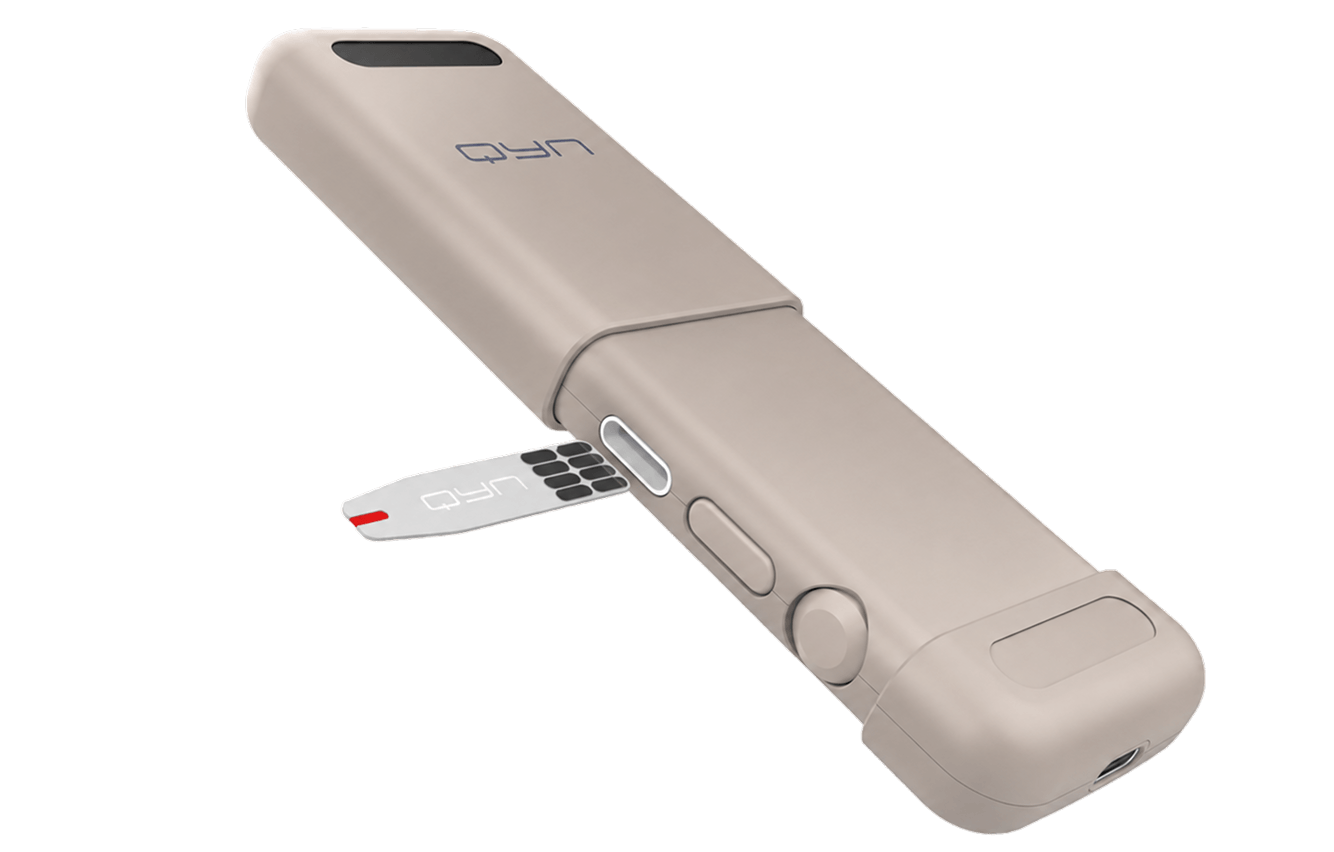
A light beige Qyn medical device with buttons and a test strip being inserted.
how qyn reads the signal

Sophisticated science made useful.

Qyn uses aptamer-based sensing to recognize specific hormones in a small blood sample. Aptamers are molecules engineered to bind to a specific target. When that binding happens, Qyn reads an optical change and translates it into a measurement.

Frequently asked questions

Does blood mean I will need to go to a lab?
No. Qyn is being designed for at-home use from a small blood sample. The final collection experience is still being developed and validated, so we are intentionally not locking the public story to one collection method yet.
Does Qyn test saliva, urine, or sweat?
No. Qyn is being built around blood. The comparison above is there to explain how different sample types work and why Qyn chose blood.
Why not just use wearable signals to estimate hormones?
Wearables can provide valuable context such as sleep, HRV, temperature, activity, and recovery. Qyn is designed to add measured hormone levels to that picture — not replace the wearable data you already use.
Is more frequent testing automatically better?
Not necessarily. The goal is not testing for its own sake. Qyn is being built to reveal patterns that can add context to isolated results. Clinical utility is still being studied.
Will Qyn replace clinical lab testing?
No. Qyn is being designed to complement standard lab testing and clinical care, not replace them.

The goal isn’t more testing. It’s a better picture.

Become a QYNsider and follow what we’re building from the inside.

Join the Waitlist